Between Friends
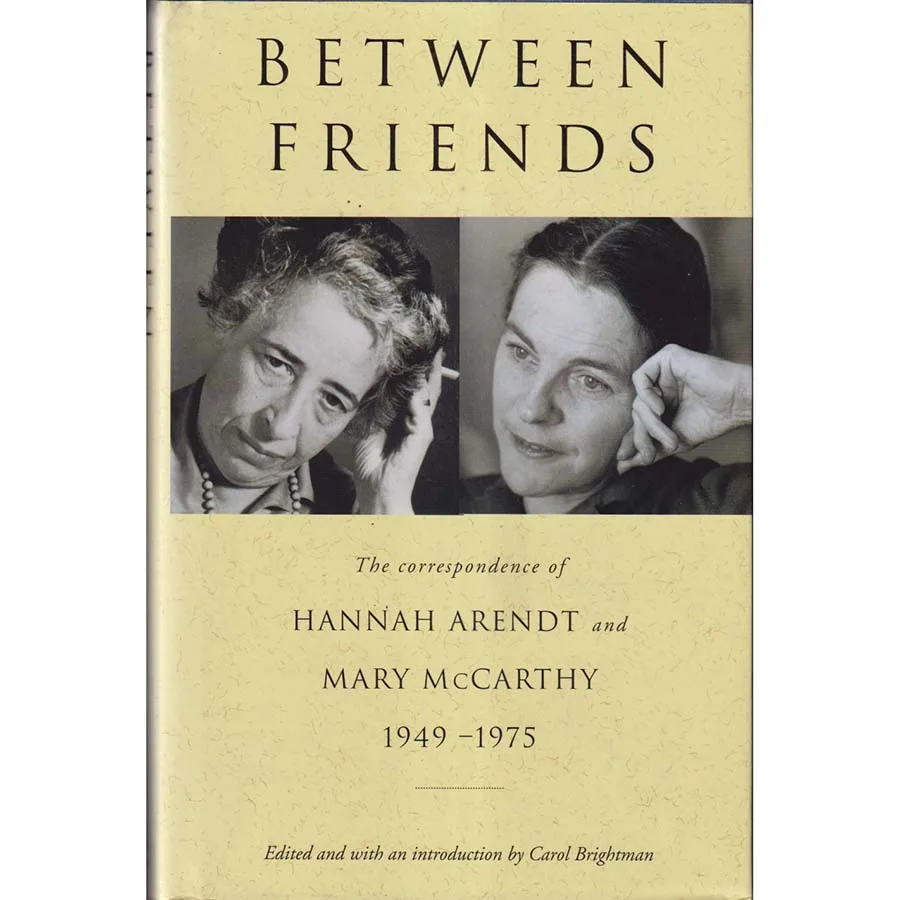
Publisher: Secker and Warburg
Format: Hardback
ISBN: 9780436202513
Between Friends: The Correspondence of Hannah Arendt and Mary McCarthy 1949–1975, published by Secker & Warburg in 1995, is a wonderfully substantial collection of letters between two formidable twentieth-century minds who apparently managed to conduct a friendship without emojis, voice notes, read receipts or the ability to send an ill-considered response three seconds after becoming annoyed.
Hannah Arendt was one of the century’s most influential political thinkers. Mary McCarthy was a novelist, critic and essayist with a famously sharp intelligence and an equally sharp willingness to use it.
Put them together for more than twenty-five years of correspondence and you do not get:
“Hope you’re well. Must catch up soon.”
You get politics, literature, marriages, books, arguments, reputations, illness, travel, publishers, intellectual disputes, mutual support and the endless practical complications of trying to lead interesting lives while also remembering to answer the post.
The correspondence began in 1949 and continued until Arendt’s death in 1975, covering a period in which both women became major public intellectual figures.
This means the letters move constantly between the intimate and the historical.
One moment somebody is discussing a manuscript.
The next, Europe, America, war, politics, philosophy or some other minor matter affecting civilisation.
Then somebody needs to complain about a publisher.
Certain things are eternal.
Part of the pleasure of a collection like this is that letters reveal people differently from finished books.
Published work has been revised.
Arguments have been sharpened.
Unnecessary remarks have theoretically been removed.
Private correspondence is messier.
Opinions arrive half-formed.
People gossip.
They change their minds.
They become irritated.
They make jokes.
They say things that would never survive an editorial meeting.
This is precisely why old letters are so addictive.
Arendt and McCarthy were intellectually serious, but the friendship was not conducted as a permanent seminar.
There is warmth, loyalty and affection here alongside discussion of ideas.
Both women had professional ambitions, complicated personal lives and strong views about almost everything, which is generally a promising recipe for correspondence.
It also helps that neither was especially frightened of disagreement.
Modern culture occasionally treats friendship as though it requires constant affirmation.
Arendt and McCarthy offer a slightly more robust model.
You can admire somebody enormously and still think they are wrong.
You can disagree.
You can argue.
You can write several pages explaining why.
Then you can remain friends.
Apparently civilisation once permitted this.
The book is also an extraordinary cultural record.
Across these letters appear writers, critics, academics, political figures and the machinery of twentieth-century intellectual life.
Books are being written and reviewed.
Ideas are being attacked and defended.
Careers rise and wobble.
Public controversies intrude into private friendships.
And somewhere behind all of it are two women trying to make sense of the world while living inside it.
For readers interested in Arendt, McCarthy, literary correspondence, twentieth-century thought, women writers, politics or cultural history, Between Friends is the sort of book that can be read slowly over weeks rather than consumed in one sitting.
It is less like reading a conventional biography and more like being allowed into a conversation that lasted a quarter of a century.
There is also something mildly luxurious about a correspondence this substantial.
Today we leave behind billions of messages saying things such as “On my way” and “Yep”.
They left letters discussing literature, friendship, power and history.
Future archivists may not be equally grateful to us.
This edition is especially attractive because the correspondence allows both women to remain fully themselves.
Arendt is not merely “the philosopher”.
McCarthy is not merely “the novelist”.
They emerge as friends with humour, vulnerability, judgement, affection and the occasional entirely understandable irritation with other people.
Which is reassuring.
Great minds, it turns out, also had to deal with ordinary nonsense.
Condition: Near Fine. A very well-preserved copy with only minimal signs of previous ownership or handling. In other words, considerably less battered than many friendships lasting twenty-six years.
ISBN: 9780436202513.
A rich, intelligent and deeply human collection of letters between two major twentieth-century women, full of ideas, wit, loyalty and the now almost exotic experience of having enough patience to write someone a proper letter.
Sold by Crappy Old Books — where correspondence still arrives with paragraphs.
Keep browsing: See more Biography books Other books by Hannah Arendt and Mary McCarthy